Current Reading - January 2020
I have always found it interesting to see what other people are reading and to hear their thoughts on books, especially when I have read the books myself—or when I am looking for recommendations. Not that I really need more books to read. The to-be-read pile is not exactly shrinking.
I have a bad habit of reading several books at once, so this first current-reading post will be a mixture of early impressions and random musings about the books currently competing for my attention.

I started reading The Last Wish by Andrzej Sapkowski after watching a couple of episodes of The Witcher on Netflix. The show did not immediately capture my interest. Part of the problem may simply have been misplaced expectations: I knew the series largely through the reputation of the computer games, despite never having played them, and had formed a vague idea of what the story would be like.
Having watched a couple of episodes, I was intrigued enough to pick up The Last Wish, which had been recommended to me as a good starting point. I have not finished the book yet, but so far, so good. It feels as though the television series has captured the atmosphere of the book quite well. I particularly like the way the individual adventures remain episodic while also contributing to a larger story. In that respect, it reminds me a little of Buffy the Vampire Slayer back in the day. Netflix had already renewed the series for a second season, so I was looking forward to seeing where the story would go, both on the page and on screen.
I have always liked time-travel stories, although that interest has mostly been limited to films and television. I particularly enjoyed Travelers, which had some good ideas and managed to wrap them up satisfyingly—far from a given when time travel is involved.
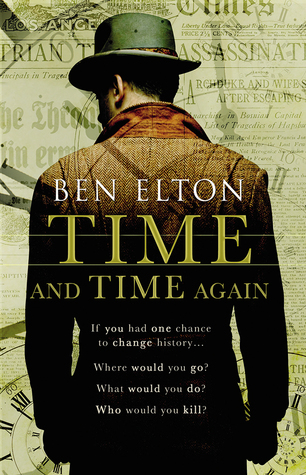
I had not explored this interest much in written form, although I read Tim Powers’s The Anubis Gates a few years earlier. I liked it enough to convince me that time-travel stories can work just as well in books. A few weeks before writing this, while looking for more time-travel fiction, I came across Ben Elton’s Time and Time Again. I was already familiar with Elton’s work, although I had never read one of his novels, so the book caught my interest.
The premise is intriguing, but I am not yet sure that the book is what I expected. It feels somewhat slow: I am already a third of the way through, and it barely feels as though the story has started. I got ambushed by other books just as things began to happen, but I expect it will become a quick read once I return to it.
On the nonfiction side, I have been reading The Age of Em: Work, Love, and Life When Robots Rule the Earth by Robin Hanson. I was vaguely familiar with the author, and I remember thinking, “Oh, I want to read that,” when the book came out in 2016. I did not get around to it until now, mainly because I read a review of the book on Slate Star Codex, a blog I cannot recommend highly enough.
The Age of Em attempts to model what life might be like once human minds can be emulated as software—“ems”—and how that development could reshape society. The scenario rests on many assumptions that may or may not prove true. Given how difficult it is to predict the future, however, Hanson has gone into extraordinary detail in tracing the consequences of those assumptions.
The result is unquestionably interesting and thought-provoking, and it has already raised questions that I expect will stay with me for a long time. Years later, I returned to Hanson’s scenario in The Future Might Not Be AI — It Might Be Copies of Us.
I will be back with an update on my current reading in a week or two, depending on how much actual reading I get done.
Follow-up: I returned to these books in Current Reading February.


Comments
Post a Comment